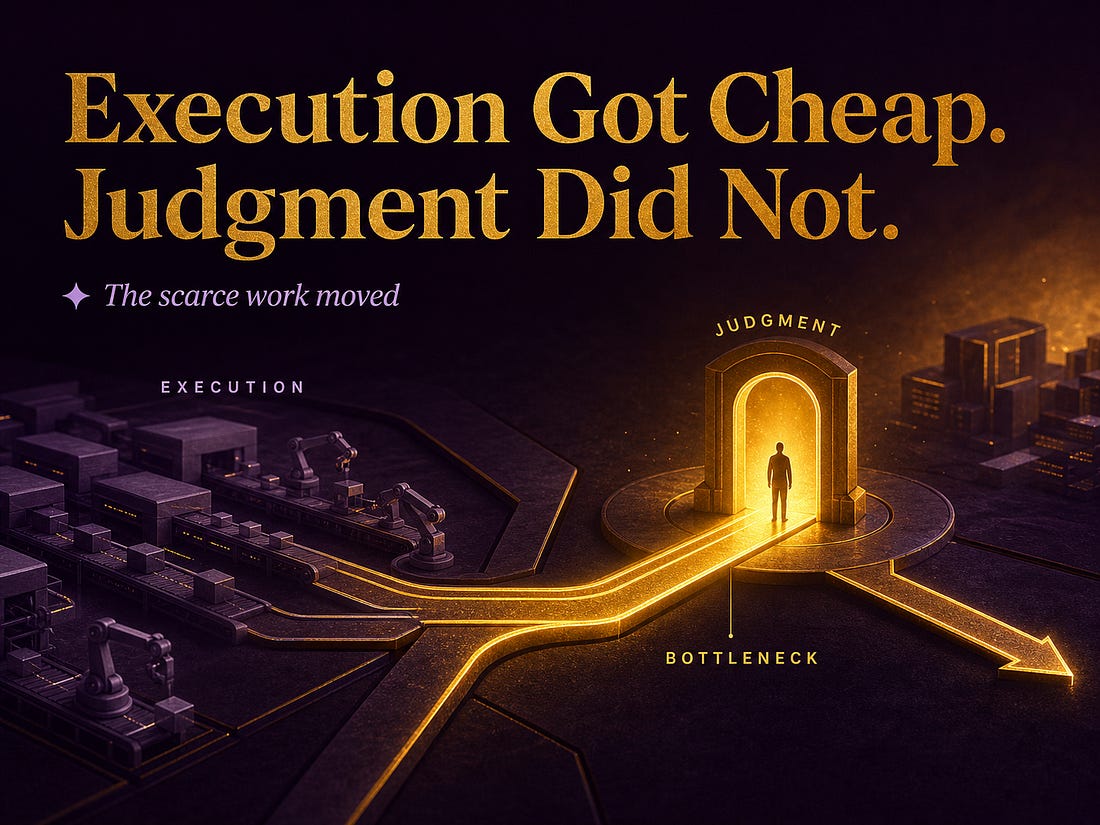
Execution Got Cheap. Judgment Did Not.
The Old Insurance Policy Costs Too Much

Organizations built rituals to protect scarce execution. Now execution is cheaper, but the rituals remain. The costliest work may be the meeting that prevents the prototype from existing.
This is the Substack sibling to the LinkedIn article, "The Bottleneck Moved. Your Calendar Didn't.". It uses the same local source base, but it changes the reader promise: less public thesis, more operating judgment for subscribers.
The Old Insurance Policy Costs Too Much
Planning rituals were rational when building the wrong thing was expensive. If a rough version can be built quickly, the cost of preventing all wrong turns can exceed the cost of learning from one.
Containerization Is The Better Analogy
When shipping got cheap, winners did not merely load ships faster. They learned what to move, where demand would be, and how to coordinate the network. AI does the same to knowledge work. It moves the constraint.
The New Constraints Are Human
Clarity, ambition, distribution, and trust do not become abundant because a model writes faster. They become more visible as the true bottlenecks. Teams that spend cheap execution on timid ideas will still underperform.
The Subscriber Takeaway
The calendar is a diagnostic tool. Count the time spent aligning before testing. If the meeting exists to protect work that could be explored directly, the organization is paying an old tax.
Subscriber Operating Lens
The calendar test should become a recurring operating review. Take a two-week sample and classify time into alignment, approval, planning, building, testing, distribution, and relationship work. Then ask which meetings existed only because building used to be expensive.
The answer will be uncomfortable. Some rituals still protect important judgment. Others protect execution that can now be explored directly. The point is not to cancel every meeting. It is to move human attention toward the new constraints: clarity, ambition, distribution, and trust.
For subscribers, the management challenge is reallocating attention. Cheap execution only creates advantage when leaders spend the saved time on better questions, braver bets, and faster learning loops.
What To Inspect Next
The practical test is not whether the argument sounds right in a strategy discussion. It is whether the organization has a repeatable way to capture the reasoning that would make the next similar decision better informed.
That means asking three questions after the relevant decision:
What assumption did we rely on?
What exception did we allow?
What would a future person or agent need to know before making the next call?
If the answer disappears after the meeting, the organization has not built memory. It has only produced activity.
Closing Note
The deeper story across this thread is that AI does not only make work faster. It raises the value of context. The firms that learn how to preserve reasoning will get better with each cycle. The firms that do not will move faster without learning faster.
Shivanath Devinarayanan, Chief Digital Labor and Technology Officer at Asymbl. These views are my own.