Governing the Front Door: API Manager, Omni Gateway, and the Autodiscovery Trap
When the policy exists but traffic still finds the wrong door

Newsletter note: This is part of a five-part MuleSoft operator series focused on practical integration, governance, and Agent Fabric readiness.
Shivanath Devinarayanan, Chief Digital Labor and Technology Officer at Asymbl
The policy can exist.
The API can exist.
Traffic can still enter through the wrong door.
API Manager is not policy dust. The front door governs traffic only when runtime, API instance, credentials, client contract, flow binding, and gateway mode line up.
https://docs.mulesoft.com/gateway-home/
https://docs.mulesoft.com/mule-gateway/mule-gateway-config-autodiscovery-mule4
https://docs.mulesoft.com/gateway/latest/policies-included-client-id-enforcement
Autodiscovery Is A Binding, Not A Badge
In Mule 4, autodiscovery binds an API Manager instance to a Mule flow through `apiId` and `flowRef`. The API must exist in API Manager, and the runtime needs valid Anypoint Platform credentials.
That is a runtime binding. It is not a decorative metadata sync.
Gateway Names Matter
Current MuleSoft docs distinguish Omni Gateway, formerly Flex Gateway, from Anypoint Mule Gateway embedded in Mule runtime. Mixing those names creates bad operating assumptions.
Policy support also depends on gateway mode. A policy that works in one path may not work in another.
The Decision Tree
Use this sequence before blaming API Manager.
Are consumers hitting the governed endpoint or bypassing it?
Is the API instance active in API Manager?
Does the Mule app have the right `apiId` and `flowRef`?
Did the runtime start with credentials for the right org, business group, and environment?
Is the policy supported by the selected gateway mode?
Does the client app have an approved contract?
Are headers or query params matching the policy extraction rules?
Are logs showing `401`, `429`, or only backend responses?
CloudHub Health Is Not Policy Enforcement
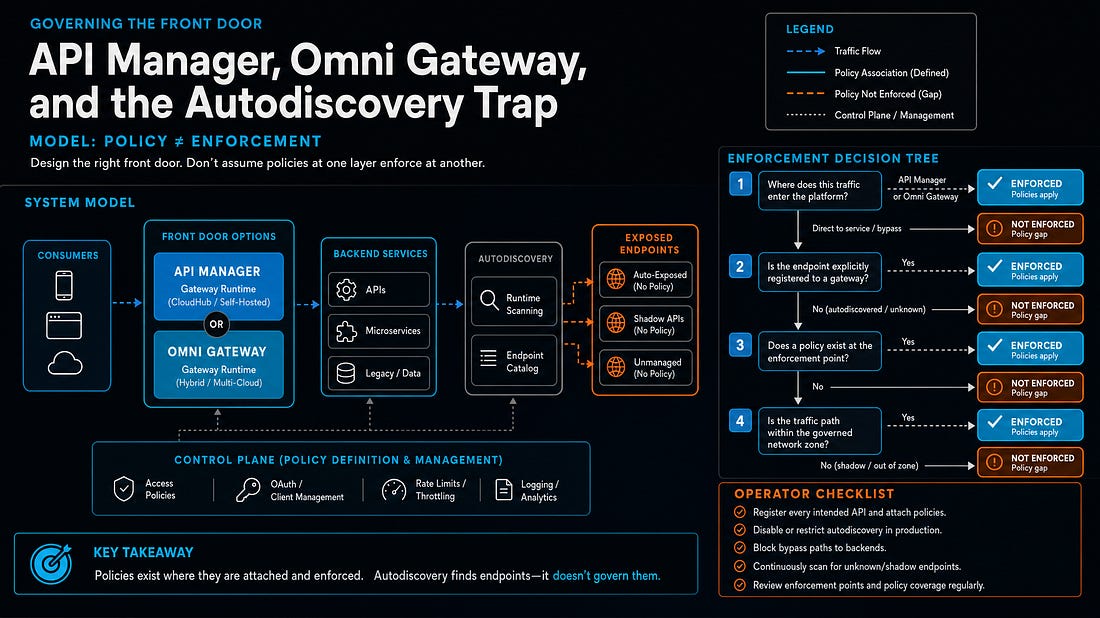
Runtime Manager tells you whether the app is deployed, running, logging, and sized correctly. API Manager tells you whether the API is governed. Those are related surfaces, not the same surface.
A healthy CloudHub app can still be reachable through a path that does not enforce the policy you thought was protecting it.
What The Docs Do Not Say
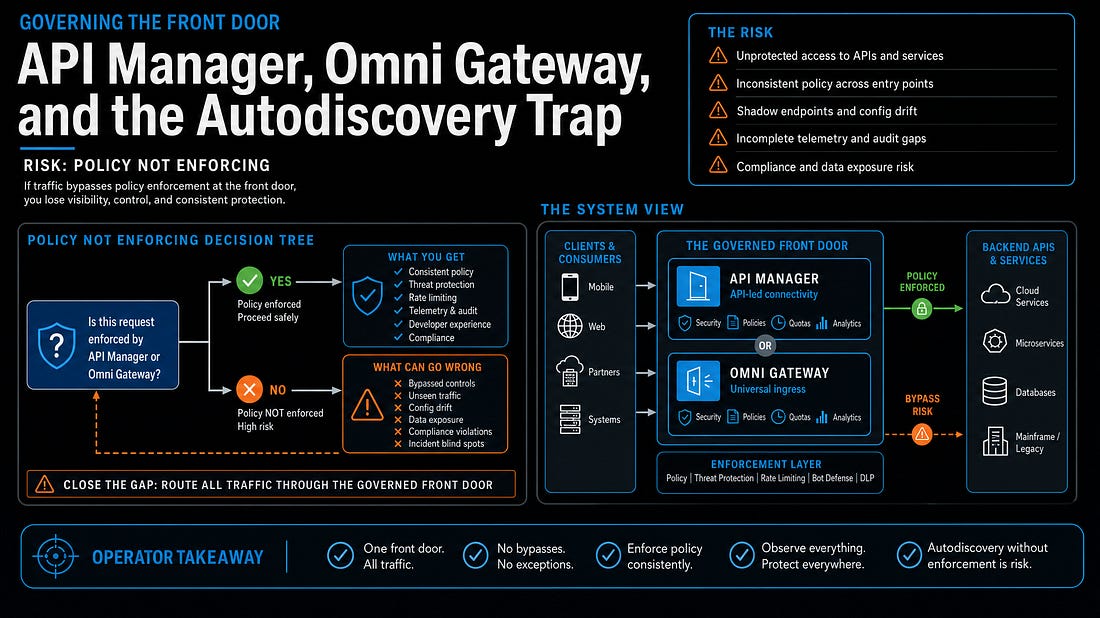
The dangerous failure mode is not policy failure. The dangerous failure mode is traffic finding another door.
A green API instance does not prove every consumer enters through that instance. A policy attached to the wrong flow does not protect the business action. A rate limit scoped per replica can surprise a team that expected one global bucket.
Operator Notes
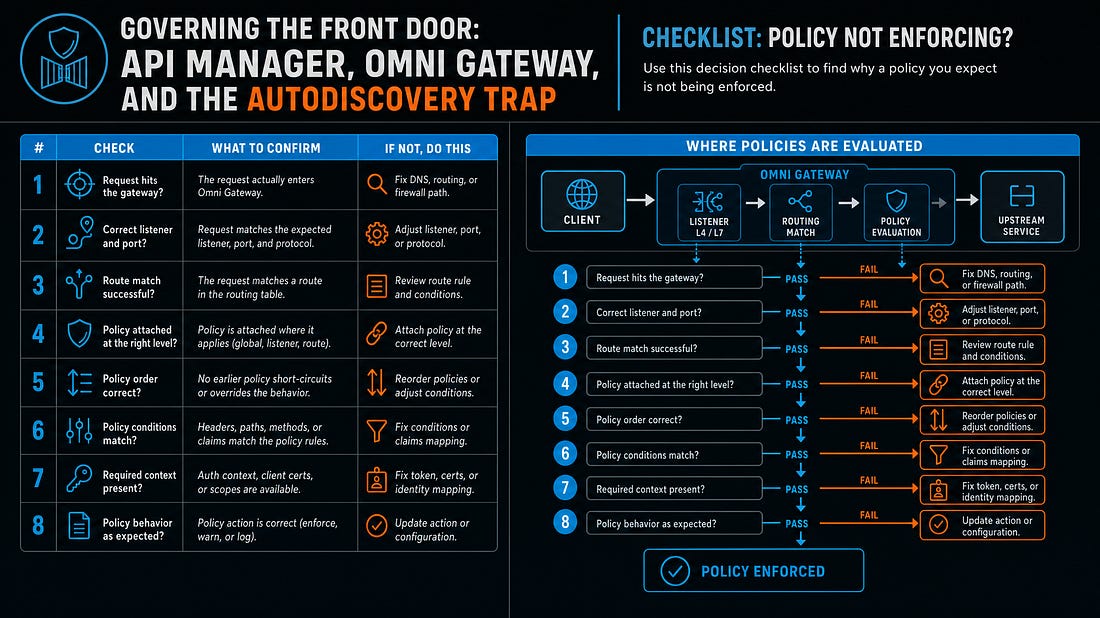
When a policy does not enforce, resist the urge to stare at the policy screen first. Follow the traffic. Which hostname did the client call? Which base path did it use? Did the request enter the managed API instance or go directly to the app? The fastest diagnosis often comes from proving the path before debating the setting.
Then check the binding. The `apiId` points to a specific API Manager instance. The `flowRef` points to a specific Mule flow. A wrong value can create the worst kind of failure: something appears configured, but the protected flow is not the flow handling traffic.
Credentials add another layer. The runtime needs platform credentials for the correct organization, business group, and environment. The client app needs an approved contract when the policy depends on client identity. The request needs credentials in the place the policy expects. Headers, query params, and DataWeave extraction expressions become operating standards, not cosmetic choices.
Rate limiting needs special care. Teams often talk about rate limits as if there is one universal bucket. The actual behavior depends on the policy, gateway mode, replicas, and storage configuration. If you do not know the scope of the counter, you do not know what protection you have.
CloudHub health can mislead teams here. A running app proves the runtime is alive. It does not prove the traffic is governed. Logs, API Manager status, policy responses, and client error behavior need to be inspected together. A backend `200` might mean success, or it might mean the request bypassed the front door entirely.
The operating standard should be simple: no API is considered governed until someone can prove the request path, API instance, flow binding, client contract, policy response, and log evidence. That proof matters even more when the next consumer is an agent tool instead of a human-triggered integration.
The Working Artifact
<api-gateway:autodiscovery
  apiId="${apiId}"
  flowRef="orders-api-main" />

apiId=12345678
What To Inspect Next
Next week: after the request enters the right door, we deal with backend semantics, canonical models, and DataWeave mediation.
Question for the comments: When a policy does not enforce, which check do you run first: endpoint path, API instance, runtime credentials, flowRef, client contract, or gateway mode?
Sources
1. https://docs.mulesoft.com/gateway-home/
2. https://docs.mulesoft.com/mule-gateway/mule-gateway-config-autodiscovery-mule4
3. https://docs.mulesoft.com/gateway/latest/policies-included-client-id-enforcement
4. https://docs.mulesoft.com/gateway/latest/policies-included-rate-limiting-sla
5. https://docs.mulesoft.com/cloudhub/managing-applications-on-cloudhub